
What Coherence Feels Like (and how to return to it)
Most people think coherence is a mood. Something you have when life is going well, and lose when it isn’t.
This article is designed to help you recognize coherence and return to it without forcing positivity, suppressing emotion, or needing the situation to change first.
What coherence is
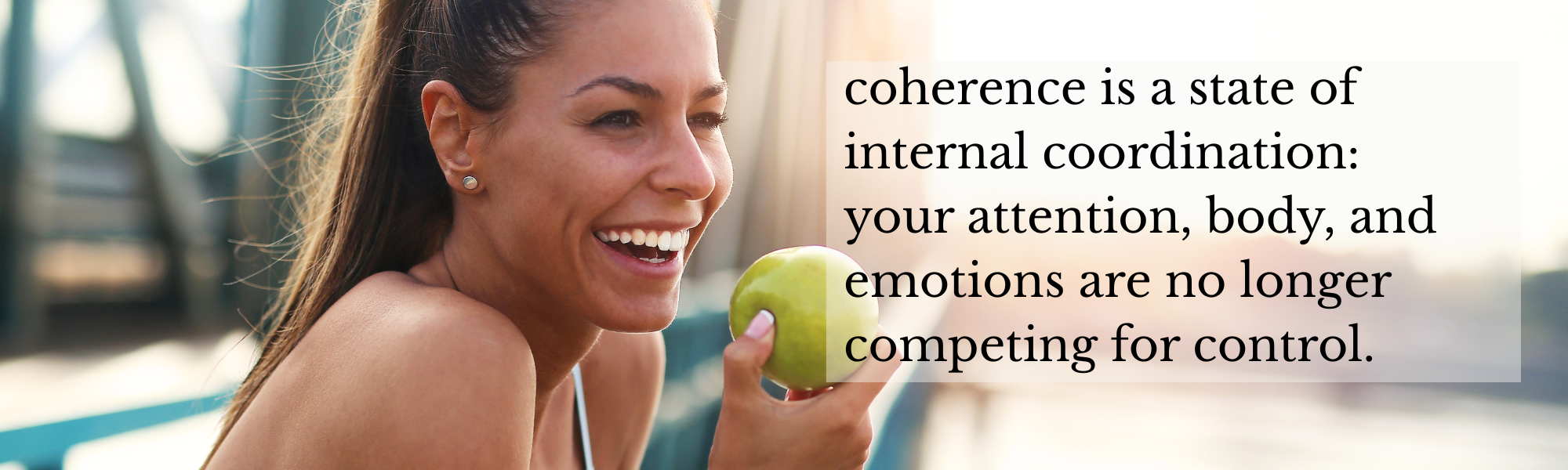
Coherence is the experience of inner alignment. It happens when:
- your attention is present (not scattered)
- your nervous system is settled enough to feel safe
- your thoughts become simpler and more organized
- your emotions become more informative than overwhelming
- your choices feel clearer and less reactive
Coherence is the moment your system stops fighting itself.
What coherence feels like
Coherence is often subtle. It may show up as:
- a quiet internal “yes” (even if you don’t know the whole plan)
- less urgency, fewer mental alarms
- cleaner thinking, fewer looping thoughts
- steadier breath
- a sense of being “here”
- emotion with space around it (you feel it, but it isn’t driving)
Many people describe it as: “Nothing changed, but I can handle it now.”
What coherence is not
- emotional numbness
- positive thinking
- spiritual bypassing
- high performance
- being “unbothered”
- pushing yourself to calm down
If you’re trying to force coherence, you’re usually activating the very system that disrupts it.
Why we lose coherence
Coherence tends to break when:
- attention gets pulled into future prediction (“what if…”)
- the body signals threat (tension, shallow breath, adrenaline)
- emotions spike without processing (anger, grief, fear, shame)
- we try to solve the feeling instead of stabilizing the system
When the nervous system believes something is at stake, the mind becomes a search engine and it starts scanning for certainty and coherence collapses into control.
The return path
Returning to coherence is not an emotional performance. It’s a sequence:
- Notice you’ve left
- Stop the acceleration
- Re-establish internal safety
- Let clarity re-emerge
Coherence returns when your system feels: “I don’t need to fight myself right now.”
How to return to coherence in 90 seconds
Try this as a reset:
Step 1: Name the state (10 seconds)
Say quietly: “I’m in speed.” or “I’m in pressure.” or “I’m in reaction.”
Naming is not analysis, it’s orientation.
Step 2: Drop attention into the body (30 seconds)
Feel one neutral physical signal:
- feet on the floor
- the weight of your hips in the chair
- the sensation of your hands
Neutral sensation is a doorway back to regulation.
Step 3: Lengthen exhale (40 seconds)
Inhale normally.
Exhale slightly longer than the inhale.
Do 3 rounds.
Step 4: Ask one coherence question (10 seconds)
Not: “How do I fix this?”
Instead: “What’s the next true step?”
Coherence gives you the next honest move.
Three action steps you can use today
- Identify your “coherence leak.”
Pick the #1 pattern that pulls you out fastest: multitasking, conflict, rushing, scrolling, perfectionism, over-explaining. - Choose a single return cue.
One cue you will use every time (example: “feet + exhale”).
Consistency builds access. - Practice coherence when you’re already okay.
Do a 60-second reset once a day when you’re not triggered.
That’s how the pathway becomes reliable under pressure.
Research-informed note
KULA’s approach emphasizes the relationship between:
- attentional control (where awareness goes)
- nervous system regulation (how safe the body feels)
- emotional integration (how emotion moves without hijacking)
- coherent decision-making (how clarity returns)
This article is educational and not a substitute for medical or therapeutic care.
Related Resources (click on link to take you to the practice)
- Returning to Center (2-minute practice)
- Attention Anchor
- De-escalation for Overwhelm
- Presence Over Performance
If you’re ready to build coherence as a skill, not a personality trait, KULA trains the inner mechanics that make it repeatable.
Join the Activation Program to learn regulation, clarity, and self-direction as a lifelong foundation.