
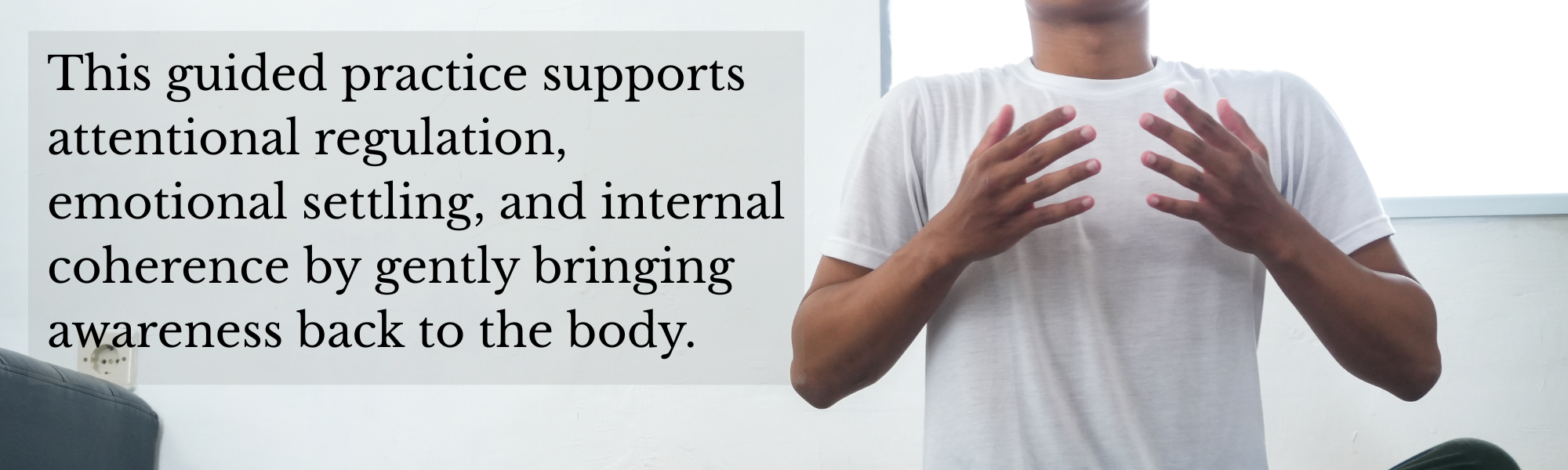
The Returning To Center Practice
A guided practice for gentle recalibration (2:21 minutes)
Rather than trying to clear the mind or solve problems, it restores access to the body’s natural regulatory systems — where clarity and discernment arise more reliably.
It can be used anytime you feel pulled in many directions, overwhelmed, or mentally overextended.
Why This Practice Works
Returning to Center is informed by research in neuroscience, stress physiology, and somatic regulation.
When attention is continually pulled toward planning, problem-solving, or emotional rumination, the brain’s stress networks remain more active. Gently returning attention to present-moment sensation helps reduce cognitive load and supports steadier regulation.
This practice supports:
- awareness of internal sensation (interoception)
• gentle orientation to the body’s center
• natural breathing without control
• soft attention rather than concentration
Key understanding: Centered awareness supports clearer thinking and steadier choice-making.
Purpose of This Practice
Under ongoing stress, the body and attention can remain in a heightened state that makes reflection and emotional steadiness more difficult.
This practice supports a gradual shift toward physiological settling and attentional clarity.
The goal is not to induce relaxation, but to allow the body’s own regulatory processes to engage.
What This Practice Supports
-
reducing stress-related physiological activation
-
supporting autonomic balance
-
stabilizing attention
-
creating a calmer internal baseline
Responses vary from person to person. Subtle shifts are common and sufficient.
When to Use This Practice
during periods of sustained stress
• after cognitively or emotionally demanding work
• before decisions or conversations
• when feeling scattered or pulled in many directions
• as a daily foundational reset
How to Engage
Find a comfortable seated or upright position.
Allow the body to be supported.
Follow the guidance at an easy pace.
There is no need to concentrate intensely or achieve a particular state.
If attention wanders, gently return to the focal point offered in the practice.
There is no correct outcome.
Research Context (Educational)
This practice draws on well-established research in stress physiology and self-regulation, including work associated with Harvard Medical School and mind-body medicine.
Kula Paradise Academy references this body of research to support understanding of regulation, without making medical or therapeutic claims.
Safety Note
If this practice brings up discomfort or feels overwhelming, stop and return attention to your surroundings.
Practices are optional and self-directed.
Seek qualified professional support if distress persists.
Kula Paradise Academy provides educational and developmental programs.
This practice is not therapy, counseling, medical treatment, or crisis intervention.